
Kategori
Blog Baru
Selection Pitfall Avoidance Guide | Five Core Questions for LoRaWAN Pressure Sensors
July 17 , 2026❓ Question 1: Is wired power available on site?
If your answer is NO → Go straight for battery-powered models. The sensor is built-in with ER26500 lithium thionyl chloride battery (3.6V), requiring no external power supply. Its theoretical service life is up to 3 years (subject to data upload frequency).
❓ Question 2: What pressure range needs to be measured?
Incorrect measuring range renders the sensor useless. The standard measuring range is 0~2.5 MPa with accuracy of ±0.5% F.S., covering pressure monitoring for most pipelines, storage tanks and industrial equipment. Custom measuring ranges are available for special working conditions (specify when placing orders).
Pro Tip: Reserve a 1.3x safety margin during selection. For example, if normal operating pressure is 1.8 MPa, a 2.5 MPa sensor is the perfect fit. Avoid operating the device at full scale.
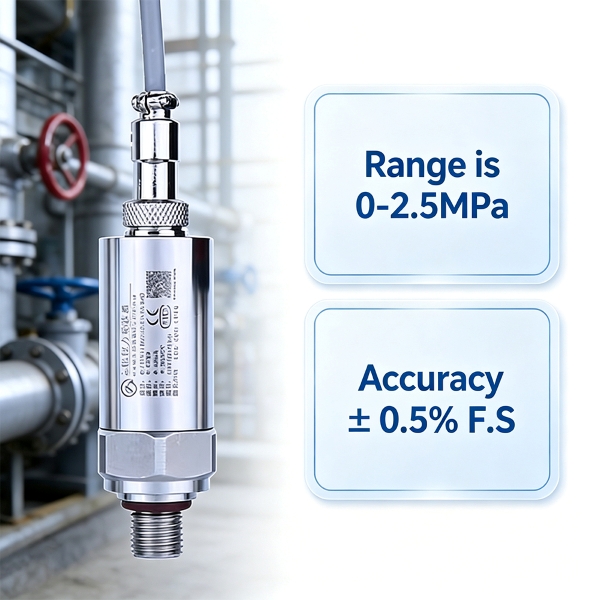
❓ Question 3: How harsh is the operating environment? (Corrosion, temperature, connection port)
Industrial sites are far from controlled laboratories. The sensor features an all-stainless steel sealed structure with oil-filled piezoresistive silicon sensing core, resistant to corrosive media. Operating temperature range: -20℃ ~ 60℃ Mounting thread: Standard M20×1.5 external thread for direct pipeline installation without adapters.
❓ Question 4: How frequent are data updates required?
Shorter upload interval equals faster battery depletion. Default data upload interval: 60 minutes, adjustable from 1 to 65535 seconds.
❓ Question 5: Is the gateway and protocol compatible?
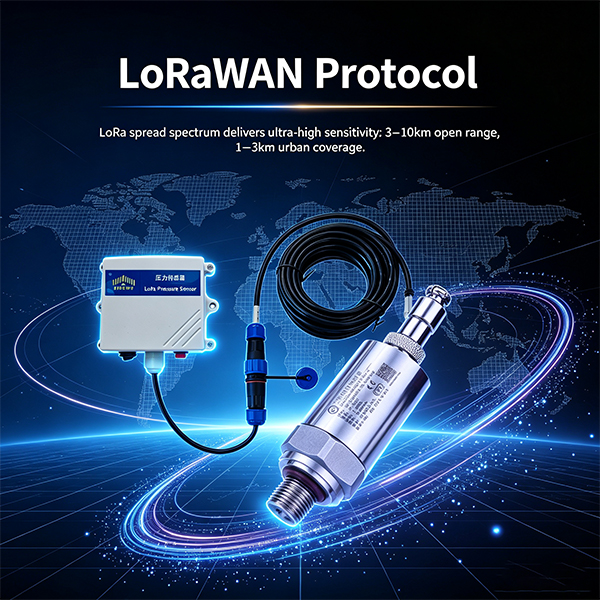
LoRaWAN is not a universal plug-and-play solution; frequency band and operating mode compatibility are mandatory checks. The sensor supports multiple frequency bands including CN470 / IN865 / EU868 / US915 / AU915 / KR920 / AS923, OTAA Class A mode, and complies with standard LoRaWAN 1.0.3 protocol.
Confirm two key points before selection: Does your gateway match the sensor’s frequency band? Does your IoT platform support OTAA activation? The default triplet credentials (DevEUI / AppEUI / AppKey) are customizable for seamless integration with third-party platforms.
Summary
Do not rely solely on datasheets. Verify three practical points in advance:
1. Is battery replacement easy? (Pluggable battery design; simply unscrew the cover for replacement)
2. Does configuration require dedicated software? (Two configuration methods: Type-C local serial port and remote command delivery)
3. Will calibration guidance be provided after sales? (Standard liquid calibration procedures are included in documents; manufacturer on-site support is available for practical application scenarios)
A well-selected sensor can run unattended for three years; a poor choice means weekly site visits for battery replacement. Wireless pressure sensors deliver hassle-free monitoring solutions — but only if you clarify your actual demands by answering these five core questions thoroughly.https://www.zonewuiot.com/wireless-iot-sensors_c13

Tel : +86 18146178586
Whatsapp : +86 18146178586
E-mel : qui@zonewu.com
Tambah : 1501-3, Building F03, Phase III, Software Park, Jimei District, Xiamen City, Fujian Province, China