
Kategori
Blog Baru
Online Nitrate Ion Sensor Selection Guide: Core Parameters & Scenario Matching
July 01 , 2026
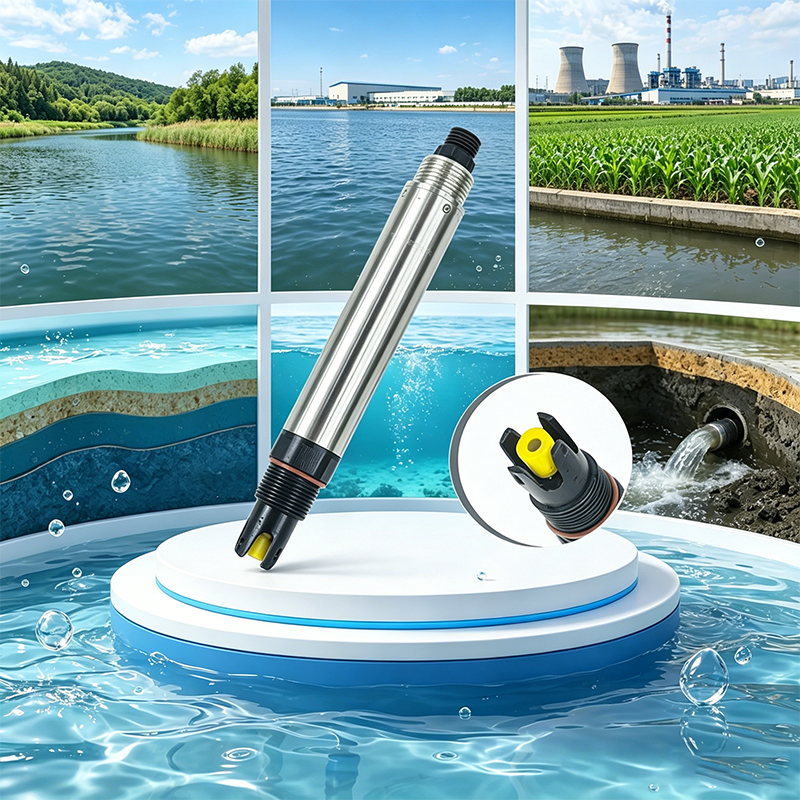
With real-time, high-precision water quality monitoring becoming mainstream, nitrate ions (NO₃⁻) act as a critical indicator for measuring water eutrophication and pollution levels. They are in high demand across drinking water safety, surface water monitoring, industrial wastewater treatment, agricultural water reuse and other sectors. Most mainstream online nitrate sensors available on the market adopt PVC membrane ion-selective electrodes (ISE), built-in Pt1000 automatic temperature compensation, and dual output of RS-485 (Modbus RTU) plus 4–20 mA, enabling seamless integration with various industrial control systems. Based on the technical specifications of typical products, this document sorts out five key dimensions for sensor selection to help users accurately match on-site application requirements.
Commercial sensors generally offer two measuring ranges: 0–100.0 mg/L and 0–1000.0 mg/L, both with a resolution of 0.1 mg/L and temperature resolution of 0.1°C. The standard accuracy is ±5% of reading or ±2 mg/L (whichever value is larger), while temperature accuracy reaches ±0.5°C.
For clean water bodies such as drinking water sources and surface water with low nitrate concentrations, the 0–100 mg/L range is recommended to guarantee superior resolution and precision at low concentrations. For industrial wastewater, agricultural drainage or heavily polluted water with high nitrate levels, the 0–1000 mg/L range is mandatory to avoid invalid data caused by over-range measurement. If on-site nitrate concentrations fluctuate drastically, prioritize wide-range models with sufficient measurement margin.
Most industrial-grade sensors support two signal interfaces: RS-485 (Modbus RTU) and optional 4–20 mA analog current output, which can be directly connected to PLCs, DCS, industrial computers, paperless recorders, touch screens and other third-party devices. The 4–20 mA output supports long-distance analog signal transmission, following the conversion formula: Measured Value = (I − 4) × FS / 16 (I = real-time current value; FS = full-scale range), making it compatible with legacy control systems.
For newly built automated systems, RS-485 digital communication is preferred for strong anti-interference performance and comprehensive data output. If the sensor needs to connect to old equipment with only analog input terminals, choose models equipped with 4–20 mA output. Pay attention to RS485 bus cable length and terminal matching, and deploy waterproof, anti-corrosion cables for field wiring.
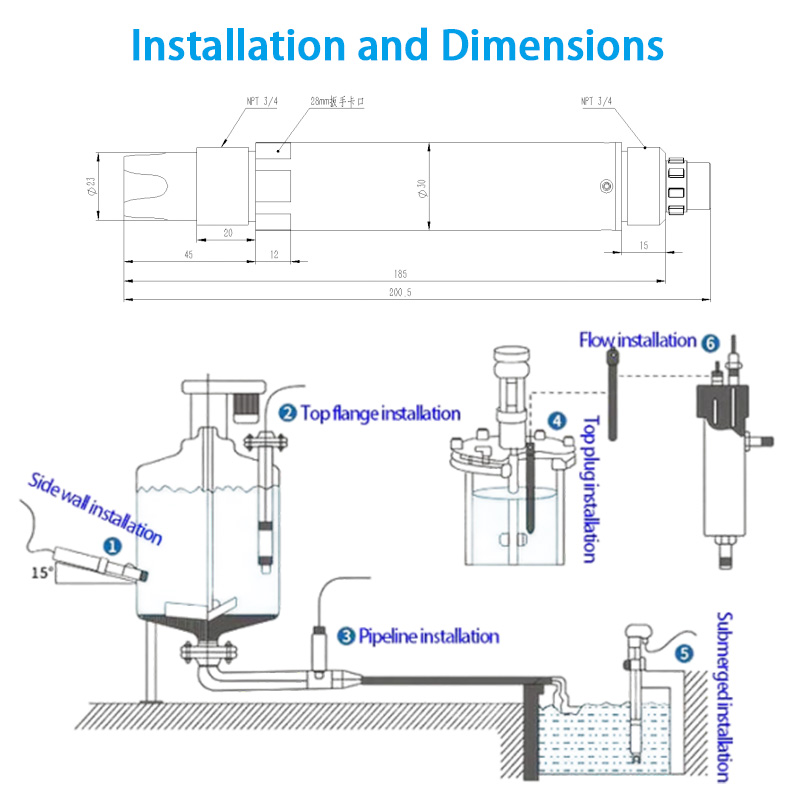
Sensors are equipped with standard 3/4 NPT thread connectors, supporting submersible mounting or fixed installation inside pipelines and water tanks. Reverse or horizontal installation is prohibited; the tilt angle shall not be less than 15° to stabilize the reference electrolyte inside the electrode. Two common housing materials are available: economical POM+ABS and corrosion-resistant POM+316L stainless steel. Both versions reach IP68 protection rating for long-term underwater immersion.
POM+ABS housings are suitable for regular fresh water and municipal sewage. For saline water, highly corrosive industrial wastewater or seawater environments, 316L stainless steel housings are required to extend service life. The operating environment shall be maintained at 0–40°C with pressure ≤0.2 MPa; pre-treatment facilities are required if site conditions exceed these limits.
As consumable components, electrodes typically have a service life of 1 to 2 years. New electrodes need to be soaked in tap water for 24 hours for activation before first use; dry storage with protective caps is required during long-term idle periods. Rinse the electrode with distilled water if the sensitive membrane turns translucent or accumulates sediment. Two-point calibration (zero point and slope) is adopted for calibration. Sensors are pre-calibrated at the factory, and recalibration is only needed when measurement error exceeds the standard threshold.
Ion interference is a hidden pitfall during model selection. Nitrate electrodes are susceptible to multiple anions including ClO₄⁻, I⁻, CN⁻, Br⁻, NO₂⁻ and Cl⁻, and the interference intensity varies with the concentration of interfering ions and nitrate ions. For instance, 10⁻⁴ M CN⁻ will introduce a 10% measurement error in a 10⁻³ M nitrate solution.
Analyze the concentration of coexisting ions in water bodies with complex water quality in advance. If necessary, select sensors embedded with interference compensation algorithms or verify data via the standard addition method. Regular maintenance including cleaning and calibration can greatly prolong the effective service life of electrodes.
Sensors operate on 12–24 V DC with ultra-low power consumption (typical 0.2 W at 12 V), making them ideal for solar-powered or battery-powered remote monitoring stations while reducing heat dissipation pressure of the whole system. A 5-meter cable is provided as standard, and customized longer cables are available upon request.
Confirm the on-site power supply type before deployment. 12 V storage batteries can directly power the sensor for solar systems; for 24 V industrial power supplies, stable voltage output must be guaranteed. For long-distance wiring, properly boost the supply voltage to offset cable voltage drop.
Sensor selection is far more than a simple comparison of technical parameters; it requires precise matching of specifications to actual application scenarios. Every factor, from measuring range and accuracy to signal interfaces, mounting structure and anti-interference performance, directly impacts long-term operational performance of the monitoring project. Before procurement, fully evaluate on-site water quality characteristics, power supply conditions and platform compatibility. Where applicable, request test data from suppliers under typical ion interference conditions. Only with properly selected sensors can monitoring data deliver its full practical value.

Tel : +86 18146178586
Whatsapp : +86 18146178586
E-mel : qui@zonewu.com
Tambah : 1501-3, Building F03, Phase III, Software Park, Jimei District, Xiamen City, Fujian Province, China